Ave!
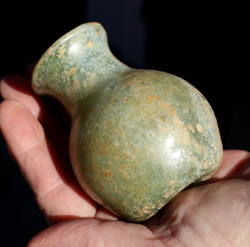
Glass Bottle, Roman, Unguentarium, ca. 1st Cent AD, Beautiful!
Glass; 75mm/44gm
Con/ As Fabricated; see the notes below.
Description/ Free-blown in pale green glass, squat piriform body, short cylindrical neck widening to body, rim everted and then folded in, flat bottom with blower's punt. Golden earthen inclusions within and without.
Seller's Note/ An unguentarium was a small, general purpose bottle, more often than not without handles. These commonly used vessels were used to hold unguents, scented oils, cosmetics, pigments, salves, medicines and dried herbs. An unguent is a soothing topical preparation spread on wounds, burns, rashes, abrasions or other topical injuries. It is similar to an ointment, though typically an unguent is less viscous and more oily. It is usually delivered as a semi-solid paste spread on the skin and is often oily to suspend the medication or other active ingredients.
The iridescence in our example is truly magnificent. In sunlight, every way you turn it, you'll discover a myriad of rainbow colors.
The largest glass manufacturing centers in the eastern Mediterranean were Alexandria and Sidon, where glass blowing was invented. Among the many references to glass in Jewish literature, there is one that mentions the glass-industry at Tiberias - Palestinian Talmud, Niddah Chap. II, Halalah 7.